A
The Alleo Team

Are you looking for ways to maximize the Dutch Work-Related Expenses Scheme (WKR) in 2026? In this blog, we dive into the WKR—a crucial tax framework that serves as a cornerstone of modern HR compensation strategy. We will also cover the latest budget updates from Prinsjesdag and show you how, as employers, you can optimize your WKR. By setting it up smartly with a solid grasp of targeted exemptions, zero valuations, and WKR tips and tricks, we will help you make the most of your available tax-free budget.
In this article, we’ll cover:
What is the Work-Related Expenses Scheme (WKR)?
What is the tax-free allowance (vrije ruimte) in the WKR?
What is the tax-free allowance in 2026?
Which targeted exemptions are available?
How employers can gain real-time insight into their WKR budget
How to maximize your tax-free allowance
How can I, as an employer, leverage the WKR strategically?
What are the key requirements for salary sacrifice?
What are smart tips for optimizing the WKR?
The Alleo WKR & Benefits Masterclass
What is the Work-Related Expenses Scheme (WKR)?
Let’s start with the basics: the WKR is a Dutch tax scheme that allows employers to provide tax-free allowances and benefits to their employees. Instead of managing dozens of individual rules, this unified framework has replaced them all. Under this scheme, a specific percentage of your total taxable payroll is designated as your "tax-free allowance" (vrije ruimte). Within this budget, you can treat your team to tax-free perks. The higher your total payroll, the larger your tax-free allowance.
Key Components of the WKR
The Work-Related Expenses Scheme (WKR) consists of several key components that empower employers to offer benefits and allowances to employees completely tax-free.
What are zero valuations (nihilwaarderingen)?
Certain benefits provided at the workplace itself are valued at €0 for tax purposes. This means they do not count towards your tax-free allowance and are fully exempt from tax. Examples include:
Use of company equipment at the workplace (such as laptops or phones).
Food and drinks consumed at the workplace (e.g., fresh fruit, coffee).
Parking spaces on the employer’s premises.
What are targeted exemptions (gerichte vrijstellingen)?
Targeted exemptions are designed for allowances and benefits with a business purpose outside of the workplace. Because these costs directly support work and are strictly business-related, you can reimburse them outside of your tax-free budget. Examples include:
Travel allowance (up to €0.23 per kilometer for commuting and business travel).
Study and training costs.
Safety equipment, such as helmets or protective clothing.
As long as you meet the conditions set by the Dutch Tax Authorities, you pay zero payroll tax and avoid the whopping 80% penalty tax on these items. This makes targeted exemptions incredibly attractive for savvy employers.
What is the tax-free allowance (vrije ruimte)?
Allowances that do not fall under a targeted exemption or zero valuation will be deducted from your tax-free budget if you want to provide them to your staff tax-free. The tax-free allowance is the portion of your total annual payroll that you, as an employer, can use tax-free for allowances, benefits, and perks. Within this budget, you don't have to pay a single cent of payroll tax.
What is the WKR tax-free allowance in 2026?
The WKR tax-free allowance for 2026 is looking more favorable than expected. Initially, it seemed that the percentages would remain the same as in 2024, but it has now been confirmed that the allowance is being expanded from 1.92% to 2% on the first €400,000 of your taxable payroll.
For 2025, the following rates apply:
Up to a taxable payroll of €400,000: 2%
Above a taxable payroll of €400,000: 1.18%
This means that depending on your total taxable payroll, you have a set amount to spend on tax-free rewards and benefits. Planning ahead is now easier than ever, provided your headcount and payroll remain relatively stable.
Please note: if you exceed your tax-free allowance, you will face an 80% penalty tax (eindheffing) on the excess amount.
This update gives you more room to offer tax-free perks, especially for companies with a payroll around or below €400,000. In our 2026 WKR Guide, you'll find an in-depth breakdown of how to strategically leverage the WKR in the new year.
How can you maximize your tax-free allowance?
By calculating your budget now, you can avoid year-end tax surprises on perks that could have easily been distributed tax-free with the right setup.
How can I, as an employer, leverage the WKR strategically?
More and more employers want to distribute their available tax-free budget fairly across their diverse teams. A great way to do this is by offering a wellbeing budget—typically between €15 and €50 per month—which employees can use for physical fitness or other wellness activities.
Another powerful strategy is giving employees direct access to the tax-free allowance through salary sacrifice. This allows employees to purchase benefits in a tax-efficient way using their gross salary. The transaction is exchanged within the WKR, meaning neither the employer nor the employee pays tax on this amount. This can boost employee purchasing power by up to 40%. For the employer, this can even yield an 18% saving on social security contributions, as it is processed within the WKR framework.
Boost employee purchasing power
Save on social security contributions
What are the key requirements for salary sacrifice?
While salary sacrifice is a highly engaging and cost-effective option, there are a few important details to keep in mind:
Impact on subsidies and thresholds: when employees lower their gross salary via a benefit exchange, it may impact their entitlement to government benefits or subsidies.
Framework and spending categories: collaborate with your team to define the best categories for your allowance, such as wellness, lifestyle, or sustainability.
A well-defined policy is key to getting this right.
What are the best tips to optimize your WKR?
There are plenty of ways to use the WKR smartly without draining your entire tax-free budget. Here are some of our favorite strategies:
Birthday gifts: use the minor gifts exemption (kleinegeschenkenregeling) to send personalized tokens of appreciation without affecting your tax-free allowance.
Lunch provisions: ask for a nominal contribution from your employees so the remaining cost can be classified as a tax-free exemption.
Trading extra holiday days: allow employees to buy or sell extra days off outside of the WKR for ultimate flexibility.
Team social clubs: set up an employee association. Have employees make a small monthly contribution, and match it tax-free as an employer. This leaves more space in your WKR for other high-value perks.
Bike scheme: consider offering a company bike lease scheme, which your team can use for commuting, completely outside of the WKR.
Want to unlock more WKR tips & tricks? Read our 2026 WKR Guide to discover how to utilize your tax-free budget to offer your team an irresistible benefits package.
How do you avoid unnecessary taxes on your allowance?
It's a missed opportunity to charge benefits against your tax-free allowance when they could actually fall under targeted exemptions instead. Take corporate fitness, for example: if it’s part of your official health and safety plan (Arboplan), it can be provided tax-free. Keeping yourself well-informed on what counts toward your WKR and what doesn't ensures you maximize your fiscal advantages.
Looking for more WKR insights?
The WKR offers endless opportunities to deliver tax-free compensation to your employees. Whether you opt for a flexible wellness allowance, salary sacrifice, or tax-exempt perks like bike leasing, smart planning and optimization will yield major savings.
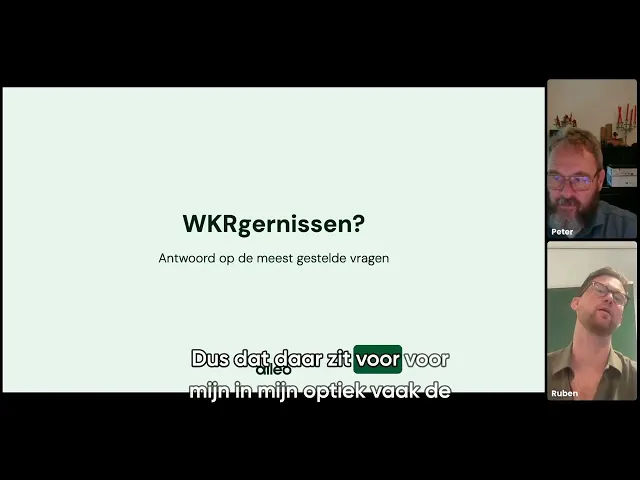
👨💻 Watch this practical masterclass, where we partner with BDO Netherlands to discuss how you can optimize the WKR to build next-level secondary benefits.
Lees ook.

Blog
The sports offering inside Alleo: from Basic-Fit and Padel to your local gym.

Blog
These 5 hotels are leading the way with personalized, modern benefits.
ENG
